

Educational 16 January 2026
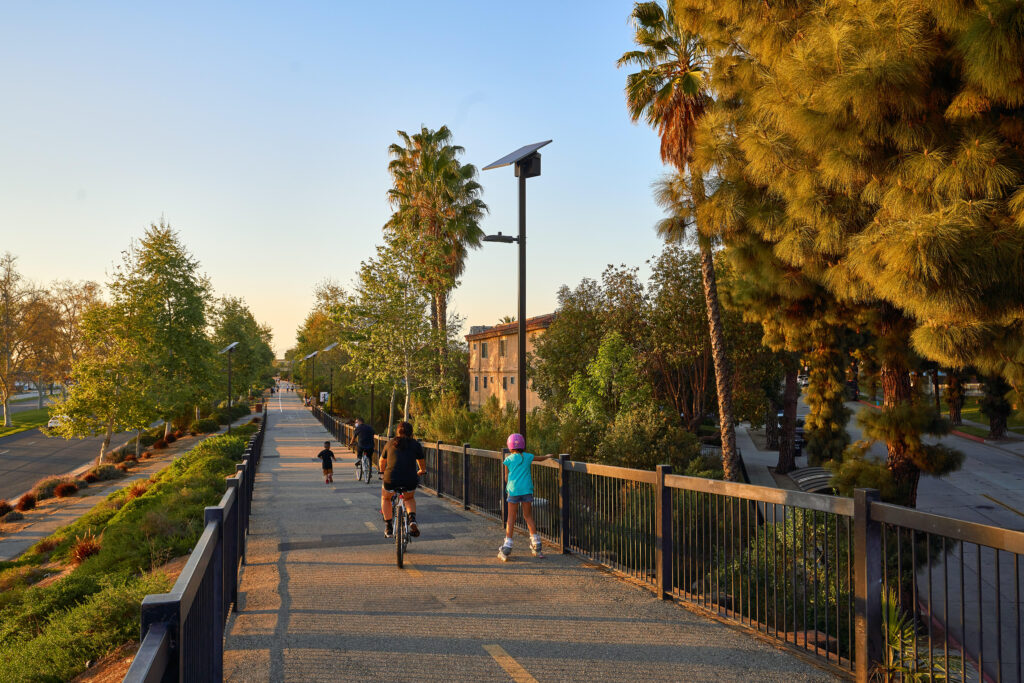
People often say good design is invisible. That it’s so intuitive and seamless you don’t even notice it. The door handle that turns the way you expect it to. The desk chair whose levers and knobs make sense without a manual. The coffee mug that nestles perfectly between your palms.
Lighting is like that too. When it’s done well, you barely register its presence—the street looks safe, the park seems inviting, the parking lot doesn’t feel like the start of a horror movie. But when the lighting is bad, you feel it. The glare, the shadows, the subtle but unshakable sense that it’s time to Get Out.
That’s because lighting isn’t just about visibility, it’s about vibe. It sets the tone for how a place feels after dark, shaping our perception of safety, comfort, and connection in ways we rarely notice. Well today, we’re noticing, and exploring how great lighting (ideally, solar lighting!) helps people feel safer, brings communities together, and keeps local economies thrumming after sunset.
That light equals safety almost seems too obvious to mention, but it’s worth unpacking. We feel safer in the light because we’ve evolved to. Long before there were cities or streetlights, our ancestors huddled around the fire to keep warm, sure, but also to keep watch. Darkness meant vulnerability and lack of control; light meant safety and the ability to see what might be waiting to pounce.
Today, the dangers have changed, but our wiring hasn’t. When we can’t see what’s around us, our brains stay on alert, reading every shadow as a potential threat. Light calms that response, giving us information about who’s there, what’s happening, and where to step next.
But it goes beyond biology. We also read light as a social signal. A well-lit street communicates activity and attention—that the space is lived in, cared for, and open for business (or pleasure). Those signals draw people in, and the more people show up, the safer a space feels.
It probably doesn’t come as a surprise that lighting makes people feel safer, but are they actually? The research is mixed. One study found turning off the street lights at night did not lead to more crime, while another reported a 39% reduction in ‘index crimes’—robbery, aggravated assault, and property crimes—after lighting was improved.
Why the inconsistency? Well, crime is messy. It doesn’t happen in isolation—it’s tangled up with poverty, policing, and a dozen other factors that are (probably, hopefully) beyond your scope of responsibility. Lighting alone can’t fix those things, and isolating its effect in the real world is tricky.
While lighting might not directly and consistently reduce crime, it definitely makes it easier to move through a space without falling on your face. It makes curbs, crosswalks, and other objects visible. It helps drivers spot pedestrians sooner and cyclists stay in their lane rather than veering into traffic. According to the FHWA, adequate lighting can reduce nighttime pedestrian crashes at intersections by 42%.
Here’s the thing about well-lit public spaces: people actually use them. Parks that might otherwise empty out at dusk stay active. Vacant parking lots become bustling evening markets. Local shops and restaurants keep their doors open longer.
That’s not just good vibes—it’s good economics. When people feel comfortable being outside after dark, they spend more time (and money!) in their neighborhoods. They grab dinner, catch a movie, meet up with friends. Small businesses get more foot traffic, which means more revenue, which means they can hire more staff or pull off that expansion they’ve been dreaming about.
And then there’s the warm, fuzzy community piece. Spaces that feel welcoming after sunset become gathering spots—the basketball court where pickup games run late, the courtyard where neighbors catch up after work, the path where joggers cross paths and exchange the universal head-nod of ‘you’re sweaty and I am too’. That casual, repeated contact builds community in ways that work and organized activities just… don’t.
It all sounds simple, maybe even obvious. But that’s the point. Good lighting doesn’t announce itself—it’s just there, making everything else possible. And with solar technology, cities are no longer limited by the grid, so more places can become the kinds of places people want to be after dark.
And that’s worth noticing.
