

It’s easy to make things complicated. Especially when the ‘thing’ you’re trying to explain involves electrical currents and charge controllers, and especially when you’re an engineer talking to someone with a background in pretty well anything besides.
Simple? That’s harder. Simple means understanding—like, really understanding—the thing. It means breaking it down into smaller pieces, using words other people use, and resisting the temptation to add ever more data, diagrams, and context. (Brevity, after all, is the soul of wit.)
With that in mind, we’re taking on the seemingly complex (but really quite simple) question: How do solar lights work? Surprisingly, we’ve never tackled this before, and we’re hoping our plain language and pretty pictures help you understand the mechanics of solar lighting a little better than you did before.
Solar lights come in all sorts of shapes and sizes. Some look like this:

Our EverGen-M solar light.
Others look like this:

An issL Maxi ‘all-in-one’ solar light.
And still others look like this:

A pole-wrapped solar light.
While they might look different, they’re effectively all made up of the same five basic parts—solar panels, batteries, controllers, fixtures, and poles. Here’s what they do:
Solar panel: Captures and converts sunlight to energy.
Battery: Stores energy for later use.
Controller: Manages when and how energy is dispensed.
Fixture: Produces light.
Pole: Holds everything up.
Easy enough, right? Next comes the hard fun part: how solar lights change sunlight into electricity.
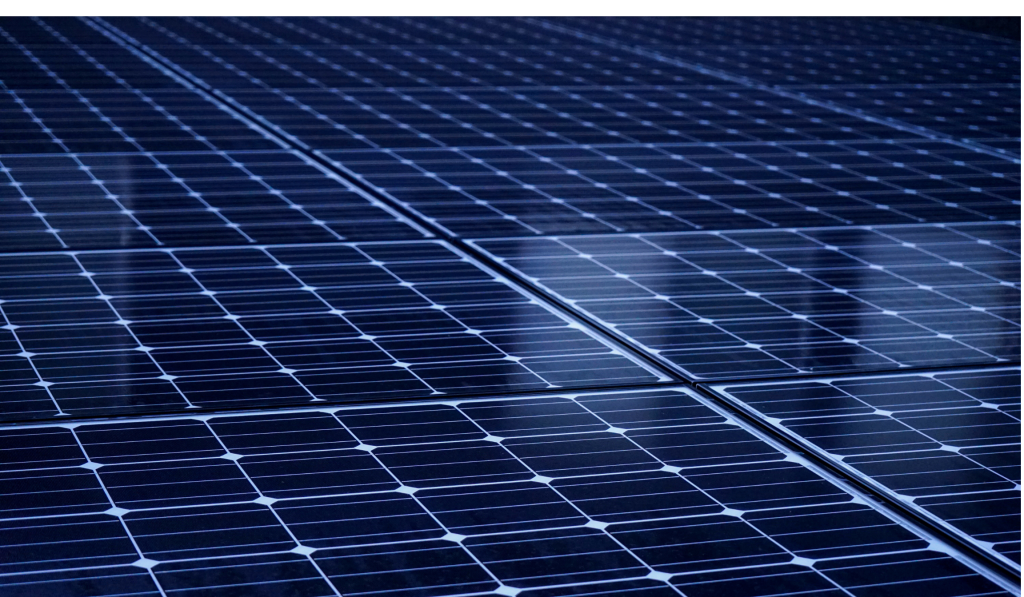
Solar panels generate electricity using something called the photovoltaic effect. It’s why you may have heard solar panels referred to as photovoltaic (or PV) panels. Each panel is made up of dozens of solar cells (or PV cells) that look like this:

Solar cells are composed of semiconductor materials, so-called because they conduct electricity better than an insulator (like plastic) but not as well as a conductor (like copper). 95% of solar panels sold today are made with silicon.

A silicon atom has 14 electrons.
When sunlight enters a solar cell, its energy (called photons) jostle against the electrons of the silicon, sometimes forcefully enough to knock them free from their ‘orbit.’ Special treatment—called ‘doping’—of the silicon makes the top layer more receptive to freed electrons than the bottom layer.
As negatively charged electrons move up, it creates a charge imbalance between the front and back surfaces of the cell. This imbalance creates something called a voltage potential, enabling a current to flow when connected to an external load (like a battery).
Think of a battery as a piggy bank or storage bin. If you needed light during the day when the sun is shining, you wouldn’t need it, but since the purpose of lighting is generally to provide safety and visibility after dark, you need someplace to store the energy until it’s needed.
Batteries are great at this. During the day, they receive energy from the solar panel, holding it in chemical compounds—anodes, cathodes, and electrolytes—inside the battery. At night, they release the stored energy to power the fixture.

Credit: UPS Battery Center
Several types of batteries are used in solar lighting systems: lead-acid, nickel metal hydride (NiMH), and lithium iron phosphate (LiFePO4) being some of the most common. Each has its own voltage, capacity, and other characteristics that make it more or less suited to a project. (Read more about that here.)
How long and how bright a system can run is largely determined by its battery type and size. Locations with abundant sunshine, like the Sun Belt, can use lower capacity batteries because they recharge daily. Locations with more variable weather, like the Pacific Northwest, need more capacity so they can last longer between charges.
We tried, but there’s no getting around the brain analogy: the controller is the brains of the solar light. It tells the light how to behave—when to switch on and off, how bright to be, and what to do with inputs from external devices like motion sensors and modems.
For example, the controller might tell the light to turn on at 100% brightness, run for three hours, then dim to 30% to conserve energy, before returning to full brightness an hour before dawn. (We call this a 3D1 profile.) You could also add motion detection to bring the light back to 100%—or any level you want—when activity is detected.

A good controller also optimizes the flow of electricity between the solar panel and the battery, and the battery and the fixture. This ensures the battery doesn’t overcharge during the day (which is damaging and potentially dangerous), and that it doesn’t run out of juice before sunrise.
There are two main types of controllers used in solar lighting: Pulse Width Modulation (PWM) and Maximum Power Point Tracking (MPPT). While PWM controllers tend to be cheaper, smaller, and perform well in sunny locations, MPPT has the edge when it comes to efficiency (they can “harvest” more energy from solar panels) and cold weather performance. Sol uses both!
Finally, the part that makes the light has multiple monikers: lamp, luminaire, and, our favorite, fixture. It includes the light source (either a bulb or integrated LEDs), the lens (the glass or plastic cover that directs the light), and the housing (the outer metal structure that gives the fixture its ‘look’).

LIthonia’s DSX0 fixture, commonly used with Sol’s EverGen systems for roadways and parking lots.
The vast majority of modern solar lighting systems use LED fixtures, which require very little energy while still delivering strong light output. They’re also built to last: many of the fixtures we power are rated for 50,000 to 100,000 hours of operation, equivalent to roughly 6 to 11 years of nightly use.
We’ve tried to provide a short, simple explainer of how solar lights work. It ended up being 1,000 words, and you might not remember it all. That’s okay. You don’t need to.
The short answer is solar lights use energy from the sun to charge a battery during the day, which powers the system at night, so you get reliable light even when the sun is gone.
That’s it. That’s the post!
If anything here didn’t quite click, or if you want to see how this works in practice, feel free to reach out. We’re always happy to help.
