

Educational 10 July 2026
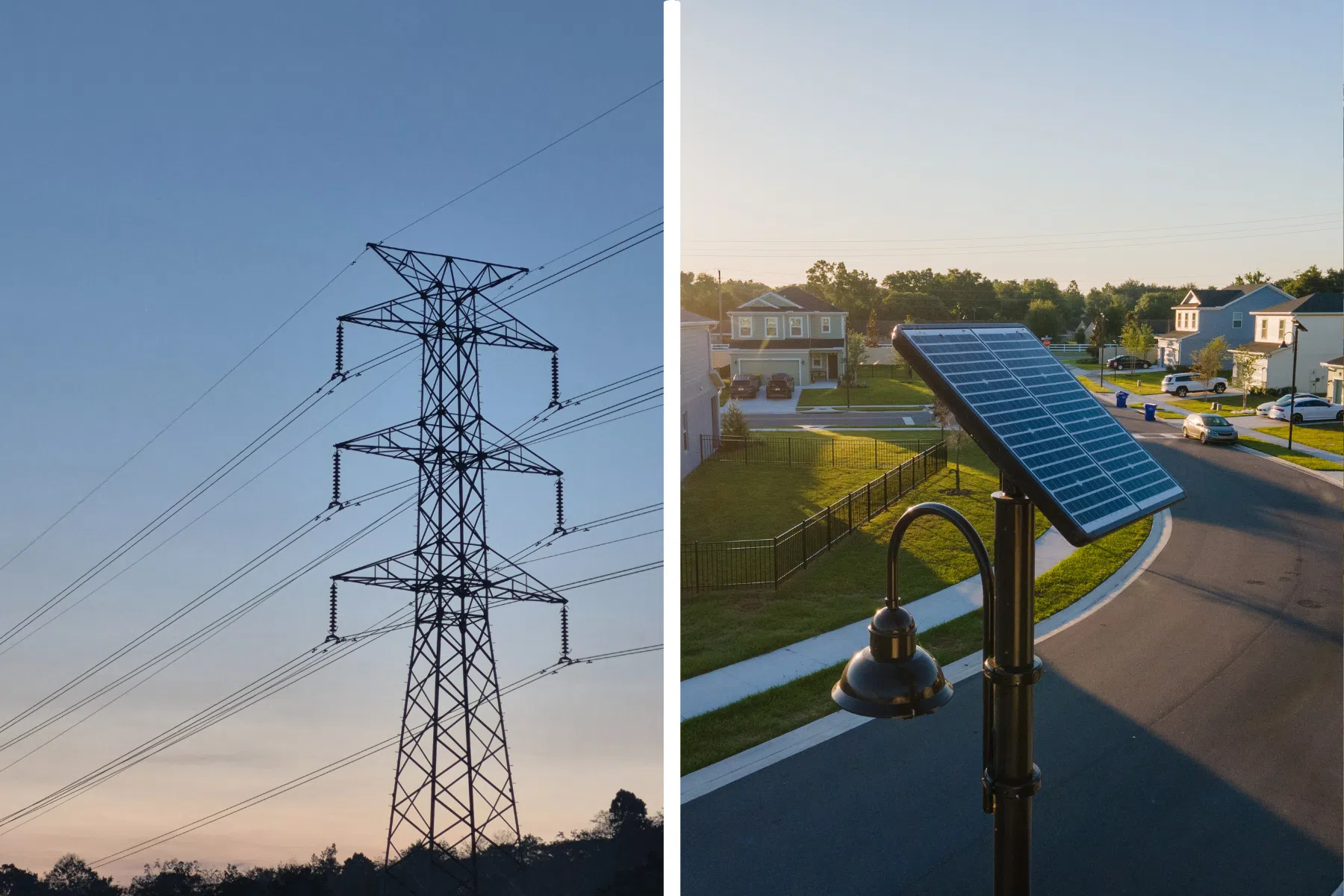
If you’re planning to light a street, pathway, park, or parking lot, chances are you’ve asked, or been asked, the seemingly simple question: “What’s this going to cost?” The answer gets complicated fast, especially once you start comparing solar lighting to conventional grid-tied systems.
For a long time, solar had a reputation as the premium choice. Clean, forward-looking, and full of promise—but not necessarily the right choice for projects that simply needed reliable light at a fair price.
We’re here to tell you: things have changed. Over the past few decades, solar and battery technologies have gotten better and cheaper, while LEDs have slashed the energy required to produce light. Meanwhile, trenching, wiring, and electricity keep pushing the cost of conventional lighting in the other direction. The two are converging, and for a lot of projects, solar comes out cheaper and greener. Here’s how the numbers really break down.
Installing grid-connected lighting involves much more than setting poles and plugging in fixtures. In many projects, it requires extensive trenching: cutting into roads or sidewalks, digging through landscaping, laying down electrical cables or conduit, then restoring everything afterward.
Costs vary considerably by surface and location, but as a rough guide: bare earth trenching typically runs $5 to $12/linear foot, but cutting through harder surfaces like concrete push that to $15 to $30. Backfilling and restoration—resurfacing what you cut through—can add another $4 to $12/foot. Urban sites tend to run higher still, due to additional traffic control and permitting requirements.
Take a 150-lot residential development. At roughly one light every 150 feet, that’s 50 fixtures. If each needs 100–150 feet of trenching to reach the next, you’re looking at 5,000–7,500 feet of digging. At a midrange $30 per foot for trenching, wiring, and restoration, the below-ground work alone runs up to $225,000—before a single pole goes in.
Solar skips this step. Each system generates and stores its own power, so installation is just foundation, pole, mount, and commissioning (programming and switching the light on). There’s still work and cost, obviously, but it’s a far cry from that six-figure trenching bill.
Historically, solar lighting systems did cost significantly more upfront than grid-tied fixtures. Today, many still do, but the gap has narrowed—and not by a little.
Solar panel costs have dropped significantly as technology has improved and manufacturing has scaled. Batteries have followed a similar path, with better energy density and more cost-effective chemistries. LEDs have also made lighting systems more efficient, allowing modern systems to deliver the same light output on a fraction of the power older systems needed.
That efficiency has a compounding effect: less power required means smaller batteries and panels, which means lighter systems that no longer need the ultra-durable (and ultra-expensive) poles and foundations solar once demanded. Our newest system, the EverGen 3, was designed around these improvements, delivering reliable performance in a leaner, faster-to-deploy system.
Grid lighting doesn’t stop costing money once it’s installed. Electricity bills accumulate, rates rise, and the network itself needs upkeep: repairs for damaged cable, failed transformers, and the ever-popular copper wire theft.
Solar sidesteps both problems. There’s no electricity bill, because sunlight is free, and there’s no electrical network to maintain, because there isn’t one. Well-built systems need very little upkeep: batteries typically last 6–10 years, while panels and fixtures often run for 15 or more.
Solar lighting costs vary by project, but the biggest drivers are light level requirements, solar availability, and battery autonomy (i.e., the number of nights the system needs to operate through poor weather).
A pathway light in a sunny climate will have very different requirements than a parking lot light in a northern region with long winter nights. A sidewalk with pedestrian lighting will be designed differently than a roadway application with higher light levels and longer operating hours.
That’s why it’s important to think of solar lighting as a complete system, not just a fixture. The panel, battery, controller, and fixture all need to be sized to work together throughout the year—not just when the sun is shining and the days are long.
To put the savings into perspective, let’s return to our 150-lot residential development example. Exact figures shift with site conditions, labor rates, and product specs, but the pattern holds: grid lighting carries heavy below-ground costs, and solar’s costs sit almost entirely above ground.
Grid-connected lighting
Estimated cost: Approximately $368,575 with ongoing expenses rising over time
Solar lighting
Estimated cost: $215,000 – and even more over time
Incentive programs like the Community Development Block Grant and Safe Streets and Roads for All (SS4A) grant can improve the math further, but they vary by jurisdiction, project type, and funding cycle, and they change often enough that it’s worth checking what’s current when you’re budgeting, rather than banking on a fixed number. Our team can help you track down which programs apply.
Solar is not always the least expensive option. If power is already nearby and little trenching is required, grid-connected lighting may still cost less upfront. But when a project involves new lighting, long cable runs, or difficult excavation, solar can quickly become the more practical and economical choice.
So the next time someone asks, “Is solar lighting really worth it?” you’ll have the answer: yes—and the numbers to back it up.
