

Educational 11 June 2026
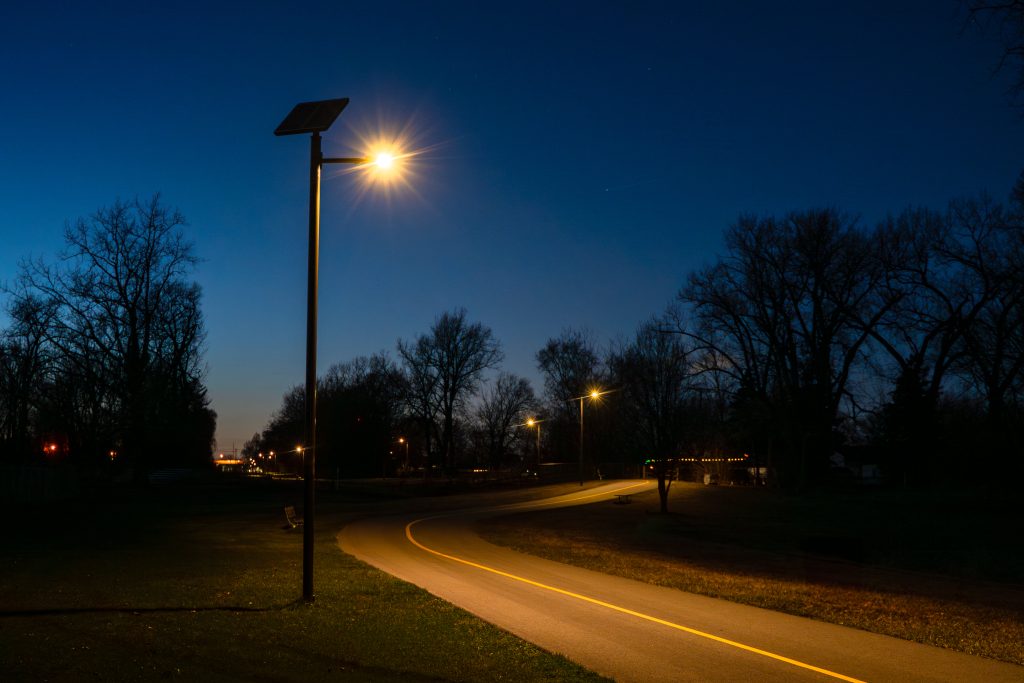
Hot take: solar lighting is not grid-powered lighting. Alright, maybe more of a lukewarm take. The difference is actually pretty obvious (there’s a solar panel), but the implications are surprisingly easy to overlook when you’re comparing products.
We often see solar lights evaluated the same way as conventional lights: by aesthetics, output, and cost. Those details matter. A solar light still needs to look good, deliver the right amount of light, and not break the budget. But it also has to do something conventional lighting doesn’t: collect, store, and manage enough energy to keep the light running as expected every night, year-round. It’s not just a fixture; it’s a whole system.
That makes product evaluation a little more complicated. Not wildly complicated. Not “you need an engineering degree to choose a pathway light” complicated. But there are a few things worth understanding before comparing products—because they can make a big difference in how the system performs over time, and because they don’t always show every system in the best, ahem, light.
Before falling for a sleek fixture, impressive lumen claim, or bargain-basement price, take a step back and consider the project itself. Where is it located? What area needs to be lit? What light levels are required? Does the light need to run at full output dusk-to-dawn, or can it dim during low-activity hours? Are there Dark Sky, color temperature, or other community requirements?
Some of those answers may already be defined in project specifications, local standards, or lighting guidance, such as the IES’ recommendations for roadways and parking facilities. Others may take a little research, or a conversation with an experienced solar lighting manufacturer. (Let’s talk.)
It might feel like a lot of upfront work, but the answers will give you something far more useful than product specs: a clear picture of what the light needs to do. Location determines how much solar energy is available. Application and light level requirements influence fixture output and distribution. The operating profile—the schedule that controls when and how a solar light operates—determines how much energy the system uses each night.
Once you know those requirements, comparing products becomes a lot more grounded. Instead of asking which light is brightest or cheapest, you can ask which system truly meets your needs. A system that performs beautifully on a trail might well be completely wrong for a collector road. Annoying, yes—but much better to know before you install it.
The simplest way to understand solar lighting is to think in terms of energy in, energy out. During the day, the solar panel collects energy from the sun. That’s energy in. The controller manages that energy, regulating the charge as it’s stored in the battery. At night, the battery powers the fixture according to the operating profile. That’s energy out. For the light to run reliably, the system has to collect more energy than it uses.
Obvious? Maybe. But that’s the core of solar lighting design. The system needs to work not only on a sunny June day, when the days are long and sunshine is abundant, but in winter, when nights are longer and solar collection is lower—sometimes a lot lower. It also needs to account for cloudy weather, temperature swings, and the reality that no site, not even Yuma, Arizona, collects the same amount of energy every day.
This is where undersized systems get into trouble. If the fixture draws more energy than the panel and battery can sustainably support, something has to give. The light may dim, run for fewer hours, or even stop working altogether.
Once you understand energy balance, you can start applying it to actual systems. The question you need to answer: How was this system sized to meet the project’s requirements?
Some manufacturers make this information easy to find. Others will make you ask—and you should. If a product claims dusk-to-dawn operation, for example, ask what that claim is based on. Is it sized around averages, or worst-case conditions? What fixture wattage is used? What runtime or operating profile is assumed? How much backup capacity is built in?
You may be able to use these details to run some rough numbers yourself, but you shouldn’t have to reverse-engineer a system from a spec sheet. A reputable manufacturer should be able to show their sizing methodology—for example, we design our systems for December 21, the shortest day of the year—explain how the components work together, and advise on whether the product is a good match for your project.
So far, we’ve focused mostly on the solar side of the system, but the light side still matters. The key here is not to fall into the lumen trap: the assumption that brighter is better. It isn’t. What matters more is where the light goes, and how evenly it’s distributed.
That’s where photometrics come in. A photometric layout shows how light will be distributed across a site using a specific fixture, optic, mounting height, and spacing. It helps answer practical questions, such as: Are there dark spots? Is the coverage consistent? Is the light going where it needs to go or ending up where it doesn’t?
It’s also worth asking how the fixture’s performance was validated. Manufacturers often quote LED chip-level output, which can look impressive but tells you very little about how the complete fixture performs. LM-79 is a standard testing method that measures the complete luminaire, optical components and all, because what matters most is the light that leaves the fixture and reaches the project surface.
Selecting a solar light isn’t about finding the brightest fixture, the biggest panel, or the sleekest design. It’s about finding a complete system that actually does the job—your job, at your site, year-round.
Here are some questions worth asking:
If the answers are clear, you’re ready to compare. If they’re hard to find, keep asking.
