

Educational 26 August 2026
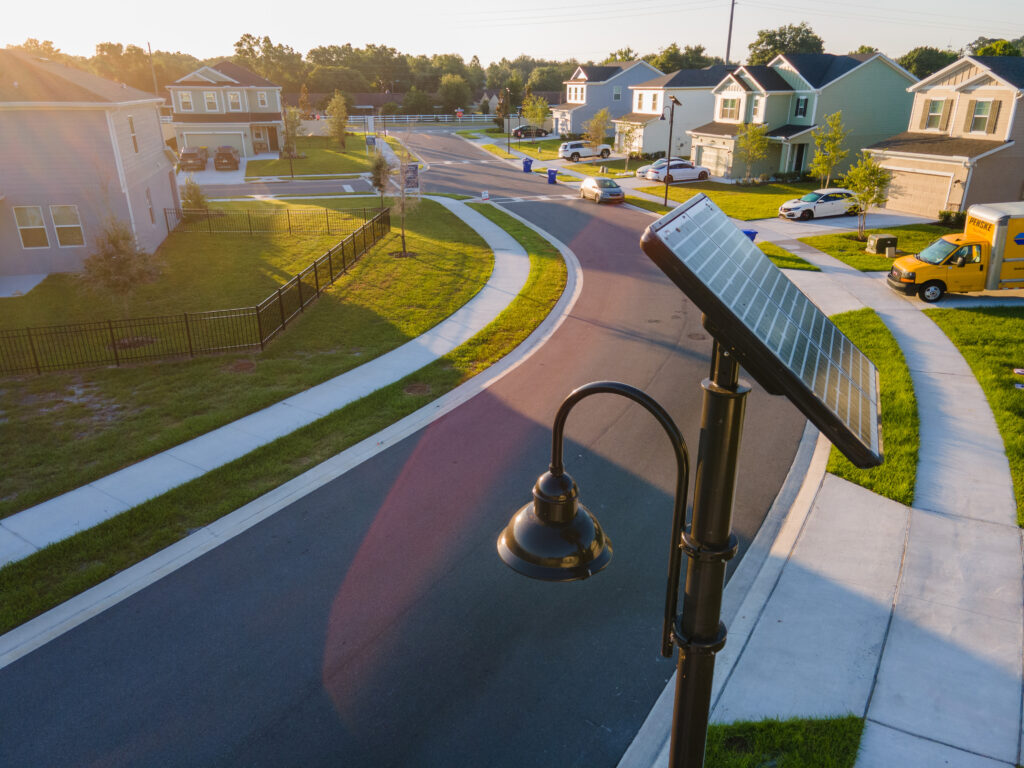
When it comes to solar lighting, size matters. And we’re not saying bigger is better—because often, it isn’t.
A well-sized solar lighting system balances energy collection, battery storage, fixture load, and operating requirements. Undersize it, and the light may dim, shorten its runtime, or stop operating during prolonged cloudy weather. Oversize it, and you may pay for larger panels, batteries, poles, and foundations you don’t need.
Here at Sol, we’ve spent decades honing our approach to solar sizing, designing systems that perform dependably without going overboard. We like to say we aim for the Goldilocks solution: not too little, not too much—just right.
So, what goes into our sizing calculations? And what should you ask other manufacturers about theirs? Let’s get into it.
Unlike a conventional light, which can draw power from the grid whenever it needs it, a solar light has to collect, store, and manage all the energy it uses. That means several pieces need to work together for the light to do its job. (There’s a reason we call it a solar lighting system.)
Four factors matter most:
The goal of sizing is to match the light’s energy needs to what the system can realistically collect, with enough battery capacity to keep it running overnight and through periods of low solar availability.
The foundation of a reliable solar light is the array-to-load ratio, or ALR: the balance between the energy collected by the solar panels (the array) and the energy used by the light fixture (the load). In simple terms:
Energy in ÷ energy out = ALR
An ALR of 1.0 is the theoretical break-even point, where the array collects exactly as much energy as the fixture uses. If it consistently collects less than it uses, the battery will eventually run down, and the light will go out—full stop.
Let’s give it a try. Say we’re sizing a system for a residential street in Los Angeles using a 40-watt LED fixture. For year-round performance, we need to account for “worst-case” solar conditions, meaning the longest winter nights. On December 21, Los Angeles sees roughly 14 hours of darkness, so running the fixture at full output from dusk to dawn would require:
40 watts × 14 hours = 560 watt-hours
That 560 watt-hours represents the nightly load. To reach the break-even ratio of 1.0, the array would need to generate the same 560 watt-hours during the day.
Of course, not every light needs to operate at full output all night. Many projects use an operating profile that adapts brightness to expected activity. By reducing output when full brightness isn’t needed, the system consumes less energy and lowers the nightly load.
For example, say we want to run our fixture at full output for three hours in the evening and two hours before dawn, then dim to 50% for the nine hours in between. (We call this a 3D2 profile.)
Assuming 50% output draws 20 watts:
40 watts × 3 hours = 120 watt-hours
20 watts × 9 hours = 180 watt-hours
40 watts × 2 hours = 80 watt-hours
Total nightly load = 380 watt-hours
Same fixture, same location, same 14-hour night—but a very different load. That’s why the operating profile needs to be taken into account when sizing a system: it directly affects how much energy the solar array needs to collect and how much the battery needs to store.
Once the energy is collected, you need somewhere to put it. Batteries are excellent at this, storing energy during the day so the light can use it at night, while also keeping some in reserve for periods of limited sun.
The catch is, not all of a battery’s capacity is intended for regular use. System designers must account for depth of discharge (DOD), the percentage of the battery’s total capacity used before recharging. A battery that is regularly discharged too deeply (past its recommended DOD) will degrade faster and need to be replaced sooner.
Let’s go back to our example. You might think that a 380-watt-hour load would require a 380-watt-hour battery, but DOD changes the math—often significantly. For example, while LiFePO4 batteries can support very deep cycling (80-90%), lead-acid batteries generally have a much shallower DOD (30-50%), so a much smaller share of their rated capacity is available for use.
To calculate the required battery capacity:
Fixture load ÷ recommended DOD = required battery capacity
Using a lead-acid battery with a recommended DOD of 50%:
380 watt-hours ÷ 50% = 760 watt-hours of battery capacity
You also need to consider backup power, or autonomy: how long the system can continue operating when solar collection is limited. Even when a system is sized for the longest winter nights, several consecutive days of bad weather can upset the energy balance. A string of cloudy days—or a full-on snowstorm—can reduce collection enough that the battery can’t fully recharge.
That’s why manufacturers build reserve capacity into their systems. Greater autonomy gives the light more time to ride out those periods without dimming or shutting off. But that resilience comes with a tradeoff: more backup generally requires more battery capacity, which adds cost and weight. The “just right” amount depends on your location, budget, operating requirements, and tolerance for reduced performance.
There are plenty of calculations that go into sizing a solar lighting system, and you don’t need to know them all—that’s what we’re here for. But the examples in this article should help you understand the assumptions behind the design well enough to spot when the math doesn’t add up.
When comparing systems, ask:
The numbers will vary from project to project. What matters is that they add up to the performance you actually need.
At the end of the day, the best solar light is the one that works as expected every night and in every season. That’s why we take sizing seriously, ensuring each system is built to perform reliably for years to come.
Need help designing the right solar lighting solution for your project? Get in touch with our team!
