

Educational 8 May 2026
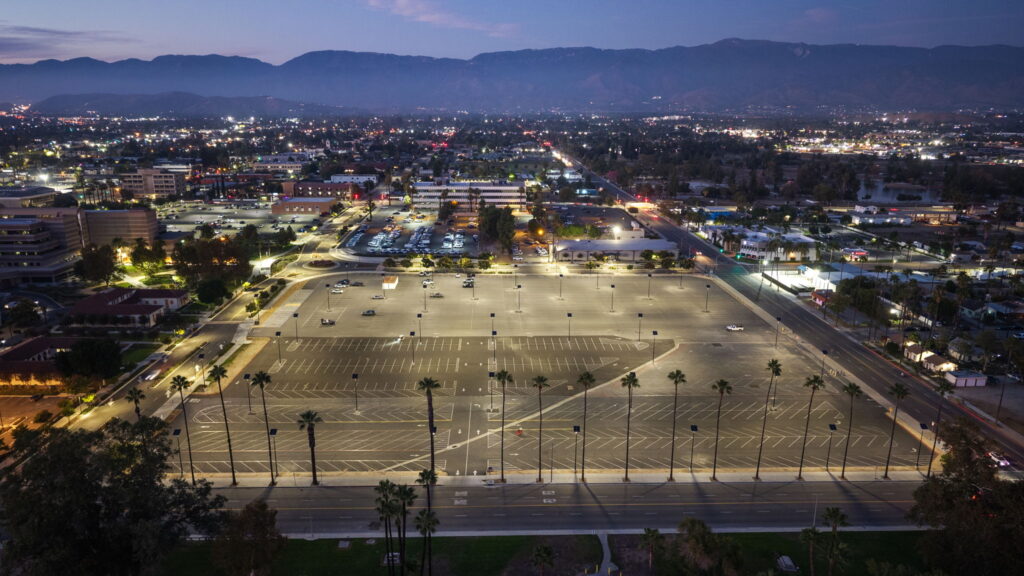
Close your eyes and picture a parking lot. Flat. Vast. Blacktop baking in the sun from dawn ‘til dusk. If you’re thinking, “Seems like an excellent place for some solar lighting,” you’re not wrong.
And yet, parking lots are a deceptively demanding lighting application. Unlike a pathway—where the occasional dim patch is tolerable because people are moving in one direction, on foot or by bike—a parking lot has to be consistent. Vehicles and pedestrians are reversing, turning, loading, unloading, and moving in every direction. A dark spot could mean someone hitting a shopping cart, tripping over a parking block, or worse…
With conventional grid-powered lighting, banishing those dark spots is no easy task. Poles have to follow existing infrastructure, whether or not it’s the best location for them. Solar systems operate independently, so layouts can be designed around lighting needs rather than grid connections. And not having to trench through acres of asphalt? Well, that’s nice too.
Before getting into benefits, it’s worth understanding the kind of light parking lots actually require. And require is the operative word: the Illuminating Engineering Society (IES) sets clear standards for parking lot lighting, and they’re a useful (if dry) place to start.
Two key metrics drive parking lot lighting design: illuminance, the amount of light falling on a surface, and uniformity, how evenly that light is distributed. For a standard commercial lot, the target is 1.5 footcandles (fc) of horizontal illuminance (light on the ground) and 0.8 fc of vertical illuminance (light on a vertical surface, like a wall or a person).
The IES didn’t pluck these numbers out of a hat. While it’s reasonable to assume that brighter is safer, research has found this is only true to a point: right around 20-30 lux (1.8-2.8 fc average horizontal illuminance). Beyond that, more light doesn’t meaningfully improve perceived safety. It just creates glare and light pollution.
Even more important than raw brightness is uniformity. Our eyes take time to adapt to changing light levels, and constant readjustment makes it harder to perceive depth, movement, and potential hazards. The IES uniformity standard for parking lots is 20:1, meaning one area can be up to 20 times brighter than another. (If that seems like a wide range, it is. Many academic studies and municipal codes push for stricter ratios of 4:1 or even 3:1.)*
Achieving that level of consistency with conventional lighting is a genuine challenge. Because poles need to tie into the grid, they’re often placed where conduit is easiest and cheapest to run rather than where light is actually needed. It’s a little like connect-the-dots art: you can draw between the points you’re given, and the picture will be recognizable, but not exactly refined…

Conventional lighting layouts aren’t so different. When pole placement is constrained by grid connections, you often end up with bright spots under fixtures, dark gaps between them, and uniformity that falls short. (You also end up with a hefty trenching and wiring bill. At roughly $30 per linear foot, even a modest parking lot project can become a serious cost-sink.)
Solar removes that constraint entirely. Since poles generate their own power, they can be installed almost anywhere you can dig a hole or set a concrete base—between parking aisles, at entrances, or deep in overflow lots. Layouts can be designed around actual lighting needs rather than electrical access, making consistent coverage far easier to achieve.
“Put the poles in the ideal configuration” isn’t exactly a simple directive. Getting consistent coverage across a large parking lot still requires careful planning, which is where photometric modeling comes in.
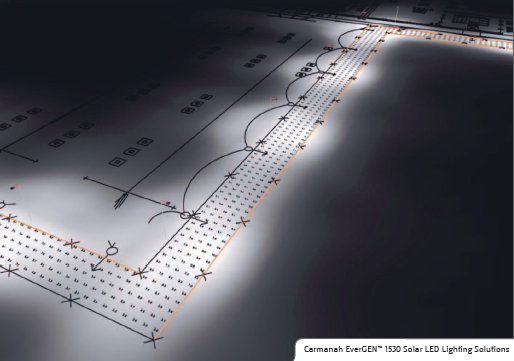
A photometric plan is a digital model showing how light will be distributed across a site using a specific fixture and optic. Parking lots typically use a combination of Type III and Type V optics: Type III for perimeter poles where outward spread is needed (it’s sometimes called a ‘batwing pattern’) and Type V for interior poles where light needs to distribute evenly in all directions.
Pole height and spacing then determine how those light patterns overlap. Too far apart, and dark gaps appear between fixtures. Too close, and you get excess brightness and glare. Most commercial lots use 20–25 foot poles spaced roughly two to three times their height to maintain consistent coverage. Solar makes it significantly easier to follow those photometric plans precisely because pole placement isn’t dictated by connection points.
Rethink all-night lighting
Once you’ve solved where the lights go, the next question is when they actually need to be on. Parking lots are often illuminated for 13 or more hours each night, but anyone who’s been to a 24-hour Walgreens at 3 a.m. knows they don’t see the same level of activity throughout. Most have clear peaks—early evening, shift changes, special events—separated by long stretches where the lot sits mostly empty.
That’s where smart scheduling and adaptive controls come in. For sites with predictable usage patterns, lighting can automatically ramp up during busy periods and dim during slow ones. When activity is less predictable, motion sensing lets the system respond dynamically. Fixtures dim during inactivity, then return to full output when movement is detected. The lot stays safely lit while reserving maximum brightness for when it’s truly needed.

That kind of efficiency matters for solar lighting—no because you’re paying for electricity, but because conserving energy overnight helps preserve battery capacity and reduces the overall system size.
Conventional lighting starts with the grid and works outward. The infrastructure drives the layout, which is why so many parking lots end up over-lit in some spots and under-lit in others.
Solar flips it. Photometrics drive the design, poles go where the light is needed, and controls optimize around actual usage rather than “just in case” or “may as well” defaults. For an application where consistent coverage is both difficult to achieve and genuinely important, that flexibility is everything.
*Uniformity ratios are sometimes expressed as average-to-minimum and sometimes as maximum-to-minimum. Knowing which you’re working toward matters enormously.
