

Educational 24 June 2026

Here at Sol, we love a good lighting spec sheet. The tables, the data, the line drawings, the satisfying specificity of it all. A spec sheet can tell you how many lumens a fixture produces, how much energy it takes to do it, what colour temperature it emits, and how long it’s expected to last.
But useful as they are, specs don’t tell you everything. They can’t predict whether light will reach the far corners of a parking lot, whether a pathway will have dark gaps between poles, or whether a fixture will create more glare than visibility. That’s because spec sheets describe individual fixtures, not how an entire lighting system will perform in the real world.
To understand that, you need a photometric layout: a site-specific plan that shows how and where light will fall before a single pole is installed.
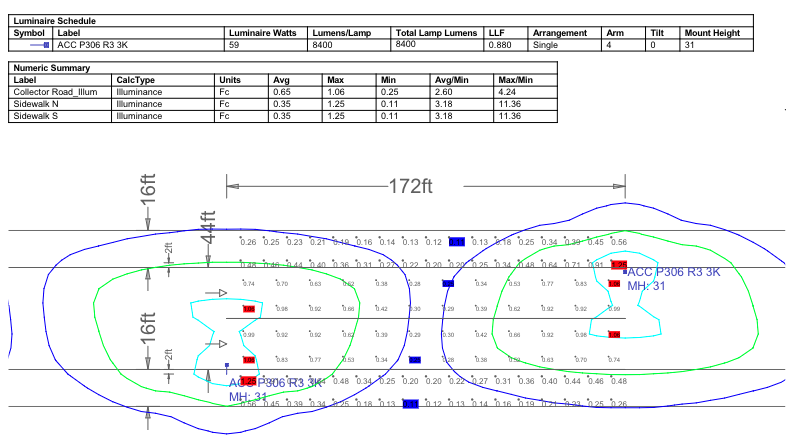
At first glance, a photometric layout can seem a little intimidating: a jumble of numbers, colors, and lines that look more like a storm tracker than a lighting design. Those numbers and lines aren’t random. They provide important information about how light is expected to behave in a space.
A photometric layout takes the performance data from a fixture—the stuff you find on a spec sheet—and applies it to a specific area. It accounts for things like pole spacing, mounting height, fixture output, angle, and distribution. In other words, it turns “this fixture makes light” into “this is where the light will go, how bright it will be, and how evenly it will be distributed.”
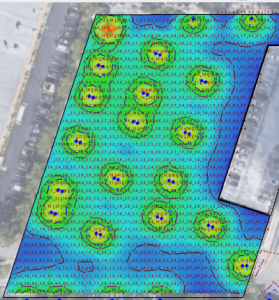

Image credit: InnoDez Design & Engineering / Green Lighting LED
Photometric layouts can take different forms. Some use color-coded heat maps, while others use 3D isometric views to highlight peaks, valleys, and overall uniformity. Your layout may not look like the examples above, but the underlying data is mostly the same, just presented in different ways. For this article, we’ll focus on one of the most common formats: a bird’s-eye view with a footcandle grid.
You don’t need to memorize a lighting textbook to understand a photometric layout, but knowing a few basic terms can help bring it into focus.
Lumens measure the total amount of light a fixture produces. They’re useful, and they’re often one of the first numbers you’ll notice on a spec sheet or photometric layout (manufacturers love to lead with their lumen counts). But lumens only tell you how much light a fixture produces overall, not how much reaches the surface you need to illuminate.
Footcandles (or lux, outside the U.S.) measure illuminance: how much light lands on a surface. One footcandle is one lumen of light spread evenly over a one-square-foot area. In a photometric layout, these are the fine-print numbers spread across the grid, showing the predicted light levels at different points across the site.
Uniformity describes how evenly light is distributed across the space. It’s often shown as a ratio, usually average-to-minimum, though sometimes maximum-to-minimum. A lower ratio means the lighting is more consistent. A higher ratio means there’s a bigger difference between the brightest and darkest areas—the kind of contrast that can make a parking lot feel more sketchy than safe.
Now that you understand the basics, let’s look at that photometric layout again. This layout, created for a section of a collector road in Los Angeles, shows the dimensions of the roadway and sidewalk, the location of each pole, and a grid of footcandle values across the calculation area.
Notice how some values are higher (like the ones directly beneath fixtures, highlighted in red) while others are lower (between poles and around the edges, highlighted in blue). These high, low, and average footcandle values are also summarized in the table, along with the uniformity ratio.
The blue and green lines are isolines, which connect points with the same footcandle value. It’s the same idea used in topographic maps, except instead of showing elevation, they show light levels. The spacing tells you how quickly the light changes across the site: evenly spaced isolines indicate a gradual transition, while tightly packed lines mean a sharper drop-off.
Beyond the grid, one detail worth checking is the light loss factor, or LLF. LLF accounts for expected changes in light output over time—because fixtures, like the rest of us, tend to dim with age. A layout using an LLF of 1.0 reflects peak performance; applying a lower LLF, like the 0.880 Sol typically uses, gives a more realistic picture of how the system will perform months or years after installation.
Once the numbers make sense, you need to know how they measure up. Lighting guidelines are set by organizations like the Illuminating Engineering Society (IES) for a variety of applications, including roadways, pathways, and parking lots. These recommendations are often adopted or adapted by local departments of transportation or other authorities responsible for outdoor lighting.
For this project, the relevant source is the LA Bureau of Street Lighting’s Design Standards and Guidelines. Since the example is a collector road, start with the Collector row in the table. We don’t know the pedestrian conflict level or pavement classification used for this project, so for the sake of illustration we’ll assume Medium/R1.
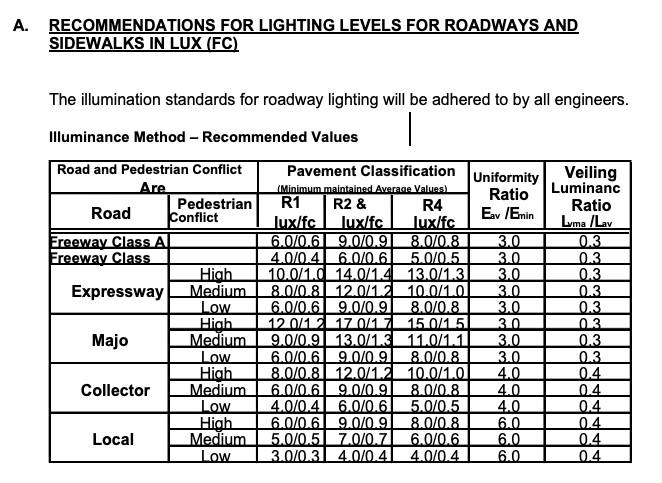
Under those assumptions, the LABSL calls for an average illuminance of 0.6 fc and an average-to-minimum uniformity of 4.0 or less (remember, less is better here). The photometric layout shows an average of 0.65 fc and a uniformity of 2.60, meaning the design meets the light level requirement and stays comfortably within the allowed uniformity ratio. Hooray!
Of course, selecting the right target isn’t always obvious. Not every city has its own street lighting standards, and even when standards exist, they may not apply, as in the case of private developments, campuses, or parks. That’s where Sol can help: by reviewing the application, identifying the correct reference, and recommending a product and configuration that can hit it.
A photometric layout is one of the best ways to check whether a lighting design is doing what it needs to do: putting enough light in the right places, keeping levels reasonably consistent, and meeting the relevant standards.
That balance matters in any lighting project, but it’s especially important with solar. A layout helps confirm that the system’s configuration—fixture output, pole spacing, mounting height, and operating profile—is aligned with the site’s actual lighting needs, without adding unnecessary light, equipment, or cost.
Sol provides photometric layouts for projects of all sizes. If you’re planning a solar lighting project and want help making sense of the numbers, reach out. We live and breathe this stuff.
